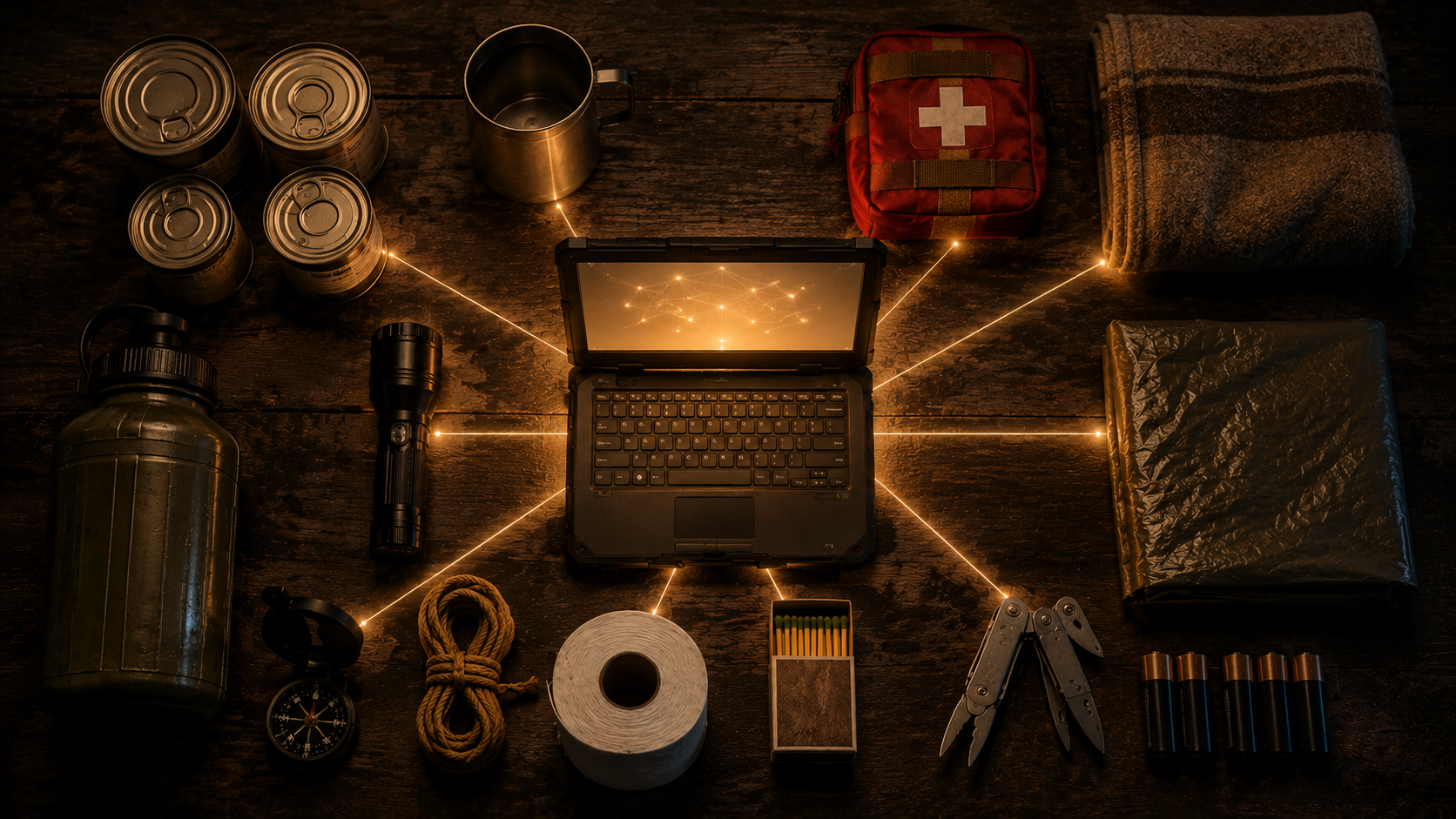
Most preparedness conversations focus on the obvious supplies: food, water, medicine, batteries, fuel, ammunition, toilet paper, and maybe a few luxuries like coffee or cigarettes. But there's another category that rarely comes up: knowledge.
If a major solar storm, cyberattack, infrastructure failure, prolonged blackout, or geopolitical crisis disrupted internet access for weeks or months, much of the world's most useful information would suddenly become hard to reach. How do you repair a generator? Diagnose an engine problem? Purify water, treat a common injury, grow food, preserve it, or build simple systems from whatever materials are on hand?
For most people, the answer today is simple: "Google it." But what happens when Google isn't available?
The Modern Survival Tool
The surprising answer may be a local AI model. For the first time in history, it's possible to carry a substantial portion of humanity's practical knowledge on a laptop that runs completely offline. Modern AI models work without any internet connection. Once downloaded, they can answer questions, explain concepts, summarize documents, troubleshoot equipment, and help you reason through technical problems. Think of it as an encyclopedia, a tutor, a mechanic's assistant, and a reference librarian packed into a single device.
Of course, AI isn't magic. Models make mistakes. That's exactly why an AI should never be your only source of information.
The Knowledge Stack
A resilient digital library pairs the model with the raw material it draws on: Wikipedia, medical references, agricultural and gardening guides, engineering and repair manuals, electrical and plumbing references, survival and first-aid handbooks, maps and navigation data, and a deep shelf of public-domain books and textbooks. Stored on a rugged SSD, the entire collection could fit in a space smaller than a deck of cards.
The AI becomes the interface to all of it. Instead of manually searching thousands of documents, you just ask:
The model points you to the relevant material and helps you interpret it.
Building an Offline Knowledge Kit
The hardware requirements are surprisingly modest. A modern laptop, a few terabytes of storage, and a reliable power source can support an impressive offline system. From there, useful additions include solar panels, battery banks, portable power stations, more rugged external SSDs, and printed backups of the most critical information.
Redundancy matters, because digital storage can fail, electronics can fail, and batteries can fail. The information you'd stake your life on should still exist in physical form.
Beyond Survival
Even if civilization never hits a major disruption, building a personal knowledge archive is worthwhile. The internet has become the default repository for human knowledge, but it's also increasingly centralized and dependent on infrastructure most people don't control. An offline library provides independence. It guarantees access to information regardless of network outages, service shutdowns, censorship, subscription changes, or corporate decisions.
Preparedness has quietly evolved. A century ago, resilience meant having tools, food, and fuel. Today it may also mean having data. The prepper's checklist still starts with the staples — but knowledge now belongs on it too.
And perhaps that one more item: a local AI model that still works when the internet doesn't.